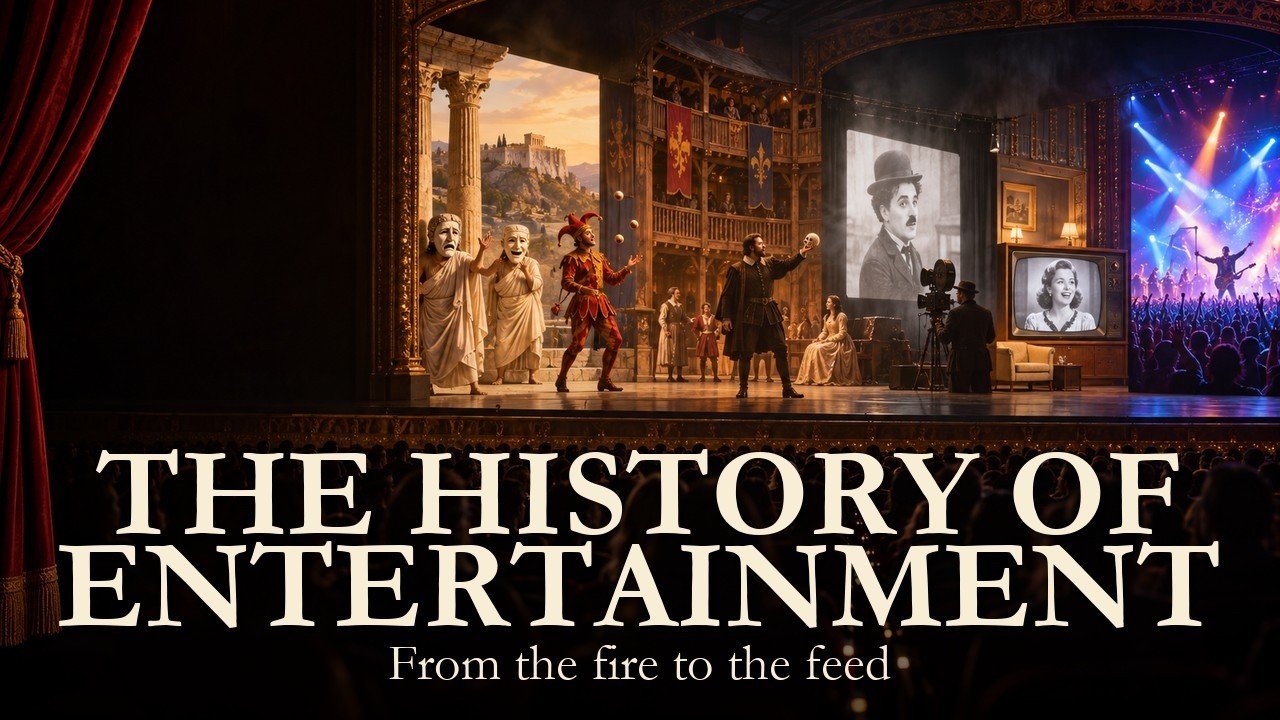
Three hours on how people have spent their spare hours: listening to a story, making and hearing music, watching someone perform, playing a game and cheering a contest. The same five pleasures run from the first fires to the phone in a pocket, and every new machine along the way, from the printing press to the camera, the radio, the television, the console and the internet, changed who could be an entertainer and who could be an audience.
It runs from stories told around the fire and the oldest board games, senet and the Royal Game of Ur; the lyres and banquets of the first cities; Thespis, the Dionysia and the theatre of Athens; Coroebus at Olympia and the ballcourts of Mexico; chariots in the Circus Maximus and the Colosseum; China’s hundred entertainments; the Thousand and One Nights and the storytellers of the markets; minstrels, jugglers and William Marshal’s tournaments; Zeami, Noh and kabuki; Shakespeare’s Globe and the first actresses; commedia dell’arte, Molière and Mozart’s opera; the novel and Dickens; Philip Astley’s circus; music hall and vaudeville; football and the people’s games; Edison, the Lumière brothers and the first cinemas; Chaplin and Hollywood; records, radio and the War of the Worlds; television; Elvis and the Beatles; Bollywood, the world’s cinemas and Studio Ghibli; Disneyland; Pong, Pac-Man, Tetris and Minecraft; the Walkman and the video shop; Me at the Zoo and Gangnam Style; to streaming, Squid Game and stadiums full of people watching other people play.
Made with AI: the narration is a synthesised voice, and the research, script and assembly were done with AI assistance. The pictures are AI reconstructions, not records of events, except the photographs from Wikimedia Commons, credited with their licences at the end, and the maps, drawn from real elevation data.
source