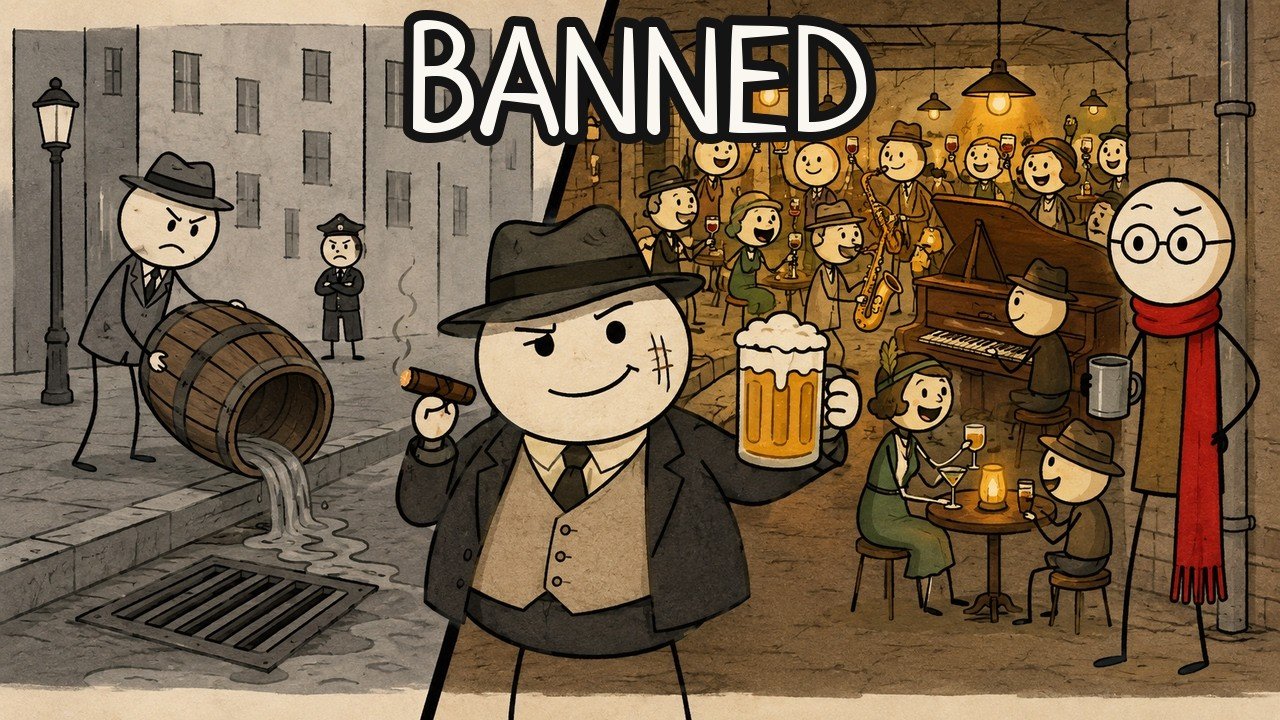
On January 17, 1920, the United States made its favourite drink illegal and hired 1,520 men to enforce it — one agent for every seventy thousand Americans. That same morning, a 21-year-old in Brooklyn had a birthday. His name was Al Capone. This is Prohibition, told with stick figures.
CHAPTERS
0:00 One job ad: 1,520 men vs 106 million Americans
1:05 The honest part: why they banned it
2:15 Wayne Wheeler invents pressure politics
3:06 The real reason was money
4:41 The hole in the amendment
6:13 The grape brick with the warning label
7:07 Rum Row and the twelve-mile fix
8:57 Would you take the bribe?
9:25 Chicago: who actually ran it
11:17 Cicero: how to buy a town
12:45 St. Valentine’s Day, 1929
13:41 The poison question
15:00 Ness — and the man who actually won
16:27 Eleven years for tax evasion
17:11 Why it ended: the money ran out
18:46 The 21st Amendment (and Utah)
19:45 Did it work? Both answers are true
The full story: the saloon that deserved killing, the woman who wrecked bars with an actual hatchet and paid her fines selling souvenir hatchets, the lobbyist who invented single-issue pressure politics and is the reason your inbox looks the way it does, and the fact almost nobody mentions — Prohibition became possible in 1913, when the income tax gave Washington a way to survive without taxing beer.
Then the loopholes: sacramental wine, whiskey on prescription, near beer and a syringe, and a legal brick of grape concentrate sold with a warning not to dissolve it in a gallon of water and leave it in a cupboard for twenty-one days, because it would turn into wine. Ships parked just past the three-mile limit until America moved the limit to twelve, which changed nothing. Three quarters of the country’s liquor crossed one half-mile river at Detroit.
And the part that should have ended the argument: for thirteen years the only nationwide, reliable, customer-focused distribution network in the United States was run entirely by people who were not legally allowed to own it.
Honesty corner: Eliot Ness did not convict Capone. An accountant in a green eyeshade named Frank Wilson did, using a form. The Fifth Amendment protects you from confessing to a crime — it does not protect you from filing.
We also cover the thing that gets left out of the jokes: in 1926 the federal government made industrial alcohol deadlier on purpose, and the estimates run to around ten thousand dead by 1933.
America once fought a war rather than pay tax on a beverage — that’s our American Revolution video, watch it next. Then it banned the beverage outright the moment it found something else to tax.
🔔 New history, fully animated, every couple of weeks. Subscribe — next time, the Great Depression.
#Prohibition #AlCapone #History #Animation #1920s
source